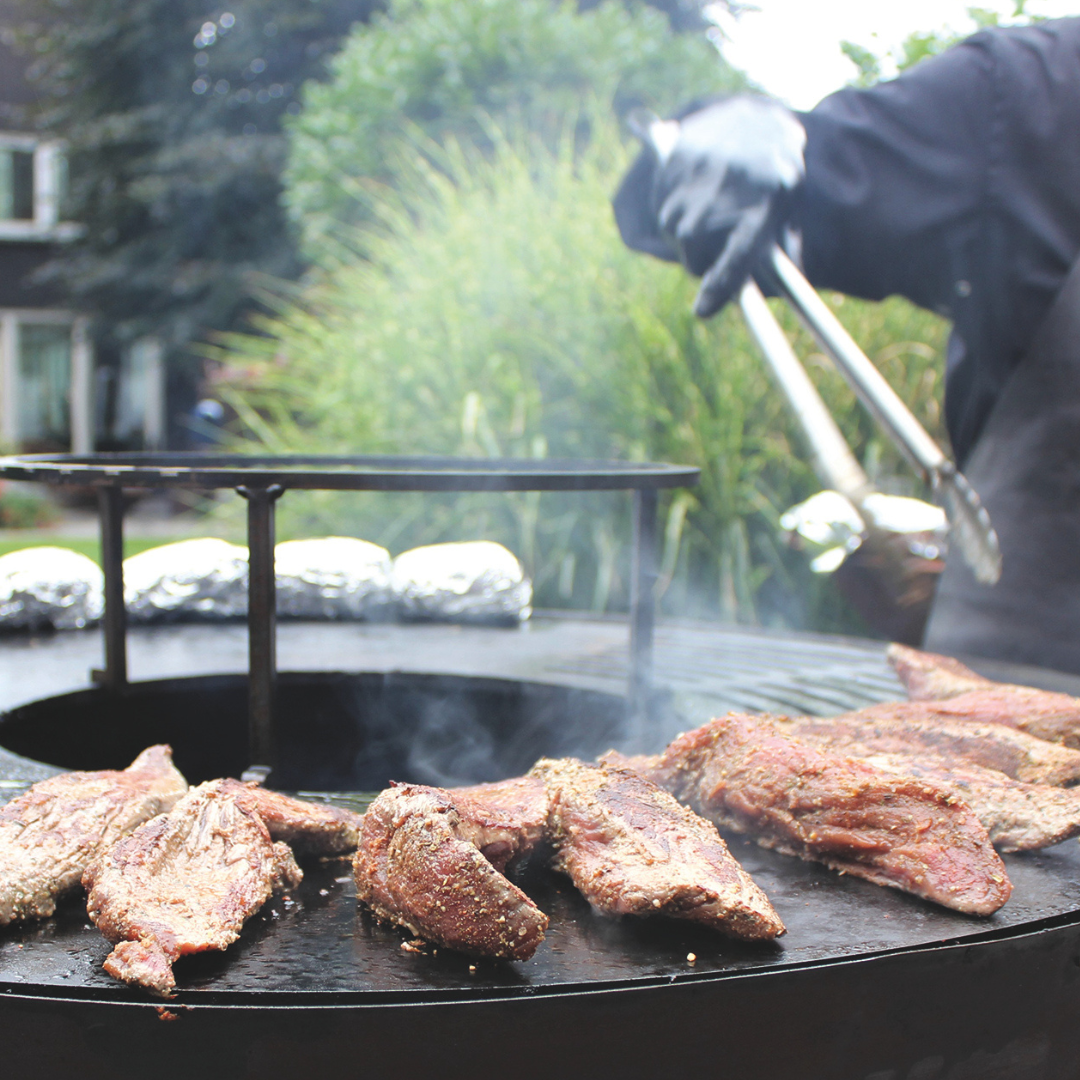

Cooking a tomahawk steak on a GrillRing requires control over temperature, timing and resting. That's exactly why the reverse sear method works so well on a wood-fired GrillRing BBQ. You first slowly build up the internal temperature on the outer section of the ring, then give the meat a hard sear close to the fire.
With a thick tomahawk steak, this approach gives you more control than grilling directly over high heat. The meat cooks evenly from edge to centre, while the fat has time to render slowly. On a GrillRing, you can then develop a deep crust without overcooking the inside.
A stable cooking setup is important for reverse searing. A spacious GrillRing BBQ with different temperature zones makes it easier to cook the steak gently before finishing it over intense heat.
Why reverse searing works well on a GrillRing
A GrillRing naturally creates several temperature zones. Close to the fire, temperatures are high, while the outer edge provides gentler heat. This makes it easy to cook a tomahawk indirectly first without constantly having to adjust airflow or grill grates.
During the first stage, place the meat on a cooler section of the cooking surface. The heat gradually moves through the steak while the outside slowly dries. This dry surface helps create a deep crust later during the final sear.
With direct grilling, the outside can become too dark while the centre is still undercooked. Reverse searing prevents this problem, especially with steaks that are four to six centimetres thick.
Preparing the tomahawk steak
Take the tomahawk out of the fridge well before cooking so the meat can cook more evenly. Pat the steak dry and season it with salt shortly before grilling. Pepper can be added later to reduce the risk of burning during the high-heat stage.
A thick fat cap doesn't need to be deeply scored. A few small, shallow cuts are enough to reduce tension while grilling. Cutting too deeply can cause unnecessary moisture loss.
Ideally, use dry hardwood that produces stable heat. Oak and beech burn steadily and provide enough heat for both the gentle cooking stage and the final sear.
Slowly cooking on the outer section of the GrillRing
Don't start directly beside the fire opening. Place the tomahawk on a moderately hot section of the GrillRing and turn the meat regularly. The aim at this stage isn't to create a crust, but to gradually increase the internal temperature with control.
A meat thermometer makes a big difference here. Remove the steak from the cooking surface at around 46–48°C if you're aiming for medium rare after the final sear.
During this stage, you'll see the fat gradually soften and the outside begin to develop a little colour. At this point, the steak is ready for the high-heat sear.
Searing close to the fire
Next, move the tomahawk to the hottest section of the GrillRing, close to the fire opening. Here, you want short, intense heat rather than prolonged cooking.
Press the meat lightly against the cooking surface to maximise contact. Because some of the fat has already rendered, the steak will quickly develop a deep brown crust. Turn it regularly to maintain control over the sear.
On a properly heated GrillRing, this stage often takes no more than one to two minutes per side. Afterwards, let the meat rest for a few minutes before slicing.
Common mistakes when reverse searing
The most common mistake is starting the high-heat stage too early. If the centre is still too cold, the steak needs to spend too long over intense heat, causing the tomahawk to lose its even doneness.
A fire that's too aggressive can also cause problems. Large flames burn the fat and can create bitter flavours on the surface of the meat.
It's also important to give the GrillRing enough time to heat up beforehand. A cooking surface that's only lukewarm won't create a proper crust and is more likely to make the meat stick.
Which GrillRing works best for thick steaks?
For reverse searing thick steaks, having enough cooking space is important, especially when you're working with several temperature zones or larger cuts of beef.
A compact setup works perfectly well for smaller dishes, but for large tomahawk steaks or cooking for several guests, a spacious fire bowl BBQ often gives you more control over heat distribution and more room to work around the fire.
🔥 Explore our fire bowls, GrillRings and plancha BBQ accessories.
🔥 Looking for more tips on cooking over fire? Discover our other blogs.