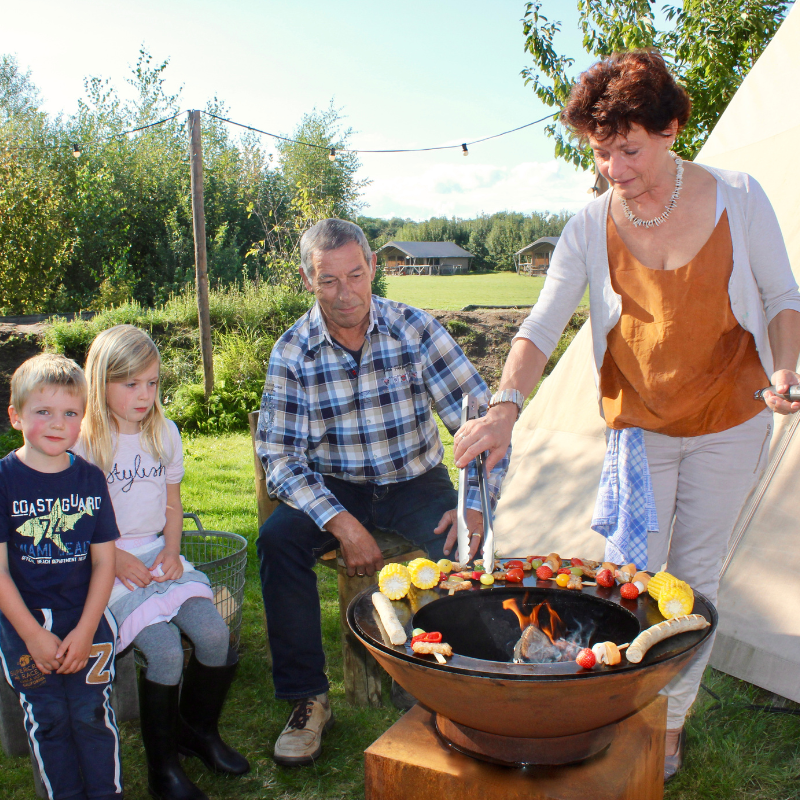

Anyone who regularly cooks on a plancha or GrillRing will quickly notice that not every part of the cooking surface has the same temperature. Directly above the fire, the heat is much more intense than at the outer edge. These temperature differences are known as heat zones.
Especially when cooking over a wood fire, heat zones make the difference between constantly adjusting your cooking and enjoying a relaxed outdoor cooking experience with more control. You can use several temperatures at the same time, without additional burners or complicated techniques. This makes a wood-fired BBQ suitable for gentle cooking, intense searing and keeping food warm during the same cooking session.
On a plancha or GrillRing, heat zones develop naturally because of the position of the fire, the thickness of the steel and the shape of the cooking surface. Understanding how these zones work helps you get much more out of a plancha BBQ or GrillRing BBQ.
How heat zones develop on a wood-fired BBQ
When cooking over a wood fire, most of the heat comes from the centre of the fire bowl. This is where the logs burn and create direct radiant heat. The surrounding steel absorbs this heat and gradually distributes it towards the outside.
This naturally creates several temperature zones:
-
A hot inner zone for searing and fast cooking
-
A medium-heat zone for controlled cooking
-
A cooler outer edge for keeping food warm or cooking more slowly
On a GrillRing, you can clearly see these zones in action. Steaks are first seared close to the fire and then moved further towards the outside to finish cooking more gently. Vegetables can stay in the medium-heat zone for longer, giving you more control over colour and texture.
Why heat zones make outdoor cooking easier
On gas barbecues, temperature is often controlled using knobs and separate burners. On a wood-fired BBQ, you work much more naturally with the heat that's already available.
This makes the cooking process more relaxed. There's no need to constantly adjust the fire or change settings. You simply move ingredients to a different part of the cooking surface.
In practice, this gives you more flexibility during social cooking. While meat rests around the outer edge, you can cook vegetables in the centre or increase the heat for the next dish.
This is a major advantage when cooking for larger groups, as different ingredients rarely require exactly the same temperature.
Which ingredients benefit from different heat zones?
Ingredients with a higher fat content or short cooking time work well in the hot inner zone. Think bavette, smashburgers or prawns. Here, you want direct contact with intense heat to create colour and caramelisation.
Vegetables often work better slightly further away from the fire. Courgette, peppers or mushrooms have more time to soften without immediately burning.
Bread, slow-cooked ingredients and dishes that need to rest also benefit from the cooler zones around the outer edge of the cooking surface.
How to recognise heat zones while cooking
Experienced outdoor cooks rarely rely on exact temperatures. Instead, they recognise heat zones by watching how ingredients behave on the cooking surface.
A few clear signs include:
-
Butter browns immediately in the hottest zone
-
Oil becomes thinner and moves more quickly closer to the centre
-
Vegetables sizzle more intensely near the fire
-
Caramelisation happens more gradually around the outer edge
After a few cooking sessions, you'll naturally develop a feel for the different heat zones on your BBQ. This often becomes more intuitive than cooking at fixed temperatures.
How wood and fire management affect heat zones
The size of your heat zones constantly changes throughout the cooking process. Dry hardwood generally provides more stable and longer-lasting heat than softer types of wood.
The position of the logs also makes a difference. Concentrating the fire in the centre creates more distinct temperature differences. Spreading the fire over a wider area creates more gradual transitions between the different zones.
On a fire bowl BBQ, this effect is particularly easy to see because the fire remains fully visible while you're cooking.
Why heat zones are part of cooking on steel
A thick steel cooking surface retains heat for a long time and gradually develops different temperatures across the plate. This makes heat zones much more stable than on thin grill grates or lightweight cooking surfaces.
That's exactly why cooking on a plancha or GrillRing can feel so controlled, even when you're working with an open fire. Instead of trying to create the same temperature everywhere, you use the properties of steel and fire together.
🔥 Explore our fire bowls, GrillRings and plancha BBQ accessories.
🔥 Looking for more tips on cooking over fire? Discover our other blogs.